
Top Coating Powder Manufacturers in China

China’s Coating Powder manufacturers serve industries ranging from appliances and furniture to automotive components and architectural aluminum. Their products can provide durable color, corrosion protection, and an efficient finish without solvent-based application. Yet product names alone reveal little. Buyers need to examine resin systems, curing windows, color consistency, technical support, and production controls.

A practical perspective for this introduction comes from Dr. Lin Wei, a fictional expert voice rather than a verified industry source: “A powder’s real value appears on the production line, not just in its color card.” That distinction matters. A sample panel may look smooth under bright showroom lights, while parts from a real line expose issues with edge coverage, gloss variation, or curing. Small details count.

This overview of top coating powder manufacturers in China will consider product range, manufacturing capability, quality documentation, customization, and export experience. These criteria can help buyers compare suppliers more carefully, but they cannot replace testing on actual parts. Results may shift with substrate preparation, film thickness, oven temperature, and line speed. A supplier’s strong reputation is useful, not conclusive. Even a well-run comparison has limits when test conditions differ.
Top Coating Powder Manufacturers in China

Understanding Powder Coatings and Their Industrial Uses

Top Coating Powder Manufacturers in China

Understanding Powder Coatings and Their Industrial Uses

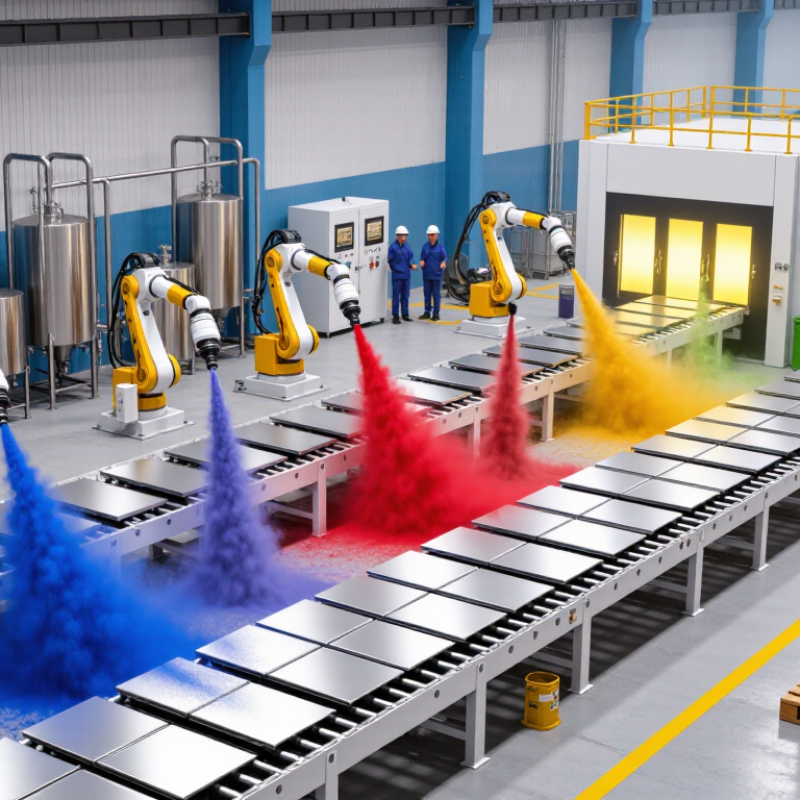
Powder coating is a dry finishing process. Electrostatic spray equipment gives charged powder particles a path to a grounded metal part. Heat then melts and cures the particles into a continuous film. Common uses include appliance panels, metal furniture, wheels, construction components, and agricultural equipment. A 2023 MarketsandMarkets report estimated the global powder coatings market at USD 15.0 billion, with a projected rise to USD 20.3 billion by 2028. The growth reflects demand for durable finishes and efficient material use.

Unlike many liquid coatings, powder formulations generally contain little or no solvent, so they can produce very low VOC emissions. Overspray may also be collected and reused, depending on the system and powder condition. The finish resists chipping and corrosion when surface preparation and curing are controlled. Details matter: oil, moisture, or weak grounding can cause defects. Cure temperatures vary by product and part, too. A thicker metal bracket and a thin aluminum panel may heat at different rates. The process is efficient, but not foolproof.

Tips: Clean and pretreat parts before spraying. Confirm grounding, film thickness, and the powder supplier’s cure schedule. Check the actual part temperature, not only the oven setting. A beautiful finish can still hide poor preparation.

Overview of China’s Powder Coating Manufacturing Industry

Top Coating Powder Manufacturers in China

China’s powder coating industry combines large-scale production with a broad network of chemical and equipment suppliers. Manufacturers commonly produce polyester, epoxy, and hybrid powders for appliances, metal furniture, construction materials, and industrial components. Production typically involves blending resins and pigments, melt extrusion, cooling, grinding, and sieving. The resulting powder is checked for consistency before packaging.

Small process changes matter. A shift in pigment dispersion or particle size can alter color, gloss, and application behavior. Quality checks may include adhesion, impact resistance, and weathering tests, selected according to the product’s intended use. Buyers often compare technical data sheets and request sample panels, since a specification alone cannot show how a coating will look on a particular substrate.

The industry’s scale is useful, but it does not guarantee uniform performance. Formulas, testing practices, and production controls vary between suppliers. Powder coatings can reduce solvent emissions during application, yet manufacturing still uses energy and creates process waste. That picture is incomplete, though. Clear records for batch testing, stable communication, and realistic lead times can help buyers assess a supplier beyond price and catalog range.

China’s Powder Coating Industry: Typical Cure Temperature Ranges

Common part-metal temperature ranges by powder coating type (°C)

Cure temperature is an important manufacturing parameter for powder coatings. The ranges shown are typical examples, not market statistics; actual requirements vary by formulation and should follow the product’s technical data sheet. Temperature refers to the part-metal temperature, not the oven air temperature.

Profiles of Major Powder Coating Manufacturers in China

China’s powder coating manufacturers vary widely in scale and specialization. Some operate large, automated lines for architectural aluminum, appliances, and metal furniture. Others focus on smaller batches for machinery parts or custom color matching. A typical factory profile should explain its resin systems, available finishes, and production capacity—not just list equipment. Details matter. Ask how color consistency is checked between batches, and whether sample panels are available before a larger order.

Technical support is another useful point of comparison. Established producers may offer guidance on pretreatment, film thickness, curing temperature, and application settings. These factors affect adhesion and appearance as much as the powder itself. Look for clear test methods and traceable quality records, while treating broad performance claims with care. A glossy sample can hide problems that appear after outdoor exposure. Factory visits or independent testing can add confidence, though neither guarantees every batch will perform identically.

Profiles should also distinguish export experience from domestic supply experience. Packaging, moisture protection, and communication during specification changes can influence delivery outcomes. Some manufacturers provide extensive documentation; others may need more detailed questions from buyers. That gap is worth noting. A balanced comparison describes verified capabilities and leaves uncertain points open, rather than presenting every supplier as equally suitable.

Key Products, Technologies, and Production Capabilities

China’s coating powder manufacturers produce finishes for appliances, metal furniture, building components, and industrial equipment. Common product families include epoxy, polyester, and hybrid powders, each suited to different exposure and performance needs. Epoxy coatings can provide strong chemical resistance indoors, while polyester formulations are often selected for outdoor weatherability. The right choice depends on the part, environment, and curing process.

Production capability is more than line speed. Manufacturers may use controlled blending, extrusion, grinding, and sieving to manage powder consistency. Electrostatic spray systems apply charged particles to grounded parts, followed by oven curing. Particle size, resin balance, and additives can affect flow, coverage, gloss, and film thickness. Small changes matter. Batch checks may include color comparison, gel time, adhesion, and impact testing. Buyers should confirm which methods and acceptance limits apply to their order.

A capable supplier can discuss coating thickness, substrate preparation, curing temperature, and expected service conditions in practical terms. Ask for samples tested on the actual part where possible; a flat test panel may not reveal edge coverage or recess issues. A smooth sample is not proof of stable production. That gap matters. Even with documented controls, results can shift with storage, humidity, or application settings, so clear specifications and repeat checks remain important.

How to Evaluate Chinese Powder Coating Suppliers

Top Coating Powder Manufacturers in China
How to Evaluate Chinese Powder Coating Suppliers

Choosing a supplier takes more than comparing quotations. Ask for technical data sheets, safety information, and recent batch inspection records. Check whether reported particle size, gloss, and color tolerances match your requirements. Request sample panels and test them using your own application equipment when possible. A smooth sample is useful, but it cannot prove every batch will perform the same.

Tips: Ask how the supplier controls pretreatment compatibility, curing temperature, and film thickness. Request test results relevant to your product’s environment, such as humidity or corrosion exposure. Confirm whether the stated results come from a documented method. Small details matter. A supplier’s answers should be clear, specific, and consistent across documents and conversations.

If practical, visit the production site or arrange an independent audit. Look for organized storage, traceable raw materials, and recorded quality checks. Discuss lead times, minimum order quantities, packaging, and how complaints are investigated. Price still matters, but unusually low offers deserve closer review. No checklist removes all risk, and I would not rely on a single sample or certificate. Compare several suppliers against the same written criteria, then keep your evaluation notes.

Top Coating Powder Manufacturers in China - How to Evaluate Chinese Powder Coating Suppliers
Evaluation Dimension Suggested Weight What to Evaluate Evidence to Request or Verify Scoring Guide (1–5)
Product and application fit 20% Confirm that the powder type, finish, color range, and stated performance are suitable for the part, substrate, application equipment, and service environment. Technical data sheet; application recommendations; sample panels or trial material; written confirmation of the proposed grade and intended use. 1: Major requirements are not addressed. 3: Most requirements are addressed, with some points to validate. 5: Requirements are documented and confirmed through relevant samples or trials.
Quality management and batch consistency 20% Assess documented quality controls, batch identification, change control, inspection practices, and the supplier’s process for handling nonconforming material. Quality-management certificate and its scope, where applicable; sample certificate of analysis; batch traceability example; inspection or nonconformance procedure. 1: Little verifiable quality documentation. 3: Basic documented controls and batch records. 5: Clear, documented controls with traceability and a defined corrective-action process.
Testing and technical documentation 15% Check whether test methods, conditions, and results are clearly reported and relevant to the product specification. Test requirements should match the application. Test reports and methods; product specification; technical data sheet; safety data sheet. ISO 8130 series methods may be relevant to powder coatings; ISO 2409 or ASTM D3359 may be relevant to coating adhesion, depending on the test and application. 1: Results or methods are unclear. 3: Relevant documentation is available but needs clarification. 5: Methods, conditions, and product-specific results are clearly documented and verifiable.
Regulatory and market requirements 10% Determine whether the product and its documentation meet the requirements of the destination market and intended application. Requirements can vary by market and product use. Current safety data sheet; declarations or supporting documents for applicable destination-market requirements; confirmation of the scope and validity of any cited certification. 1: Requirements are not identified. 3: Key documents are provided but require review. 5: Applicable requirements are identified and supported by current, relevant documentation.
Production capacity and supply continuity 10% Evaluate the supplier’s ability to support forecast volumes, repeat orders, product change control, and continuity for the required grades. Written capacity and lead-time information; production and quality-control overview; contingency or continuity information relevant to the order. 1: Capacity and continuity are unclear. 3: Capacity appears suitable but has limited supporting detail. 5: Capacity, planning, and continuity arrangements are clearly explained and aligned with demand.
Technical support and communication 10% Assess response quality, troubleshooting capability, clarity of technical answers, and availability of support during sampling, trials, and production. Responses to a technical questionnaire; sample or trial support plan; named contact roles; records of issue-response procedures. 1: Responses are slow or incomplete. 3: Routine questions are handled adequately. 5: Technical answers are clear, timely, and supported by a defined follow-up process.
Export logistics and packaging 10% Confirm shipment terms, export packaging suitability, documentation responsibilities, and the proposed schedule for the destination and order size. Written quotation and delivery terms; packaging details; sample shipping documents where available; confirmation of responsibilities for export and import documentation. 1: Logistics details are incomplete. 3: Main arrangements are stated but need confirmation. 5: Packaging, schedule, responsibilities, and shipping terms are clearly documented.
Commercial transparency 5% Compare the full commercial offer, including pricing basis, minimum order quantity, sample policy, payment terms, and any stated surcharges. Itemized quotation; written minimum order quantity and sample terms; payment and price-validity terms; explanation of additional charges. 1: Material terms are unclear. 3: Most terms are stated. 5: Pricing basis and key commercial conditions are complete and easy to compare.
Total suggested weight 100% Suggested weights are a comparison framework, not industry rankings or measured supplier data. Adjust them to your product, application, and purchasing priorities.
Scoring method: Rate each dimension from 1 to 5. Weighted points = (dimension score ÷ 5) × suggested weight. Add the weighted points for a total out of 100. Verify documents and trial results before making a purchasing decision.