Global feed buying now demands more than comparing protein percentages or choosing the lowest delivered price. Animal nutrition connects formulation decisions with growth, health, feed efficiency, welfare, and environmental performance. A bright feed mill can still produce a poor result when storage humidity, ingredient variation, or transport delays are ignored.
Professor Hans H. Stein, a respected swine nutrition researcher, offers a useful principle: “Nutrients, not ingredients, feed the animal.” His point is practical. Buyers should examine digestible amino acids, available phosphorus, energy values, fibre quality, moisture, and contaminant controls. They should also request current laboratory results, traceability records, and clear specifications from suppliers. A soybean meal label may look consistent, yet its nutrient profile can shift between shipments. Small differences matter.
This guide presents ten animal nutrition tips for global feed buyers. It considers formulation accuracy, supplier verification, storage conditions, species requirements, and changing market risks. Real decisions are rarely perfect. Price pressure can encourage shortcuts. A quick certificate review may miss a weak sampling method. Even experienced teams can overtrust historical supplier performance. That is why careful buyers compare documents with physical evidence, including odour, colour, particle size, and warehouse conditions.
The strongest approach remains disciplined but flexible. Use science, then question the assumptions behind it. Feed quality begins before the ingredient reaches the mixer.
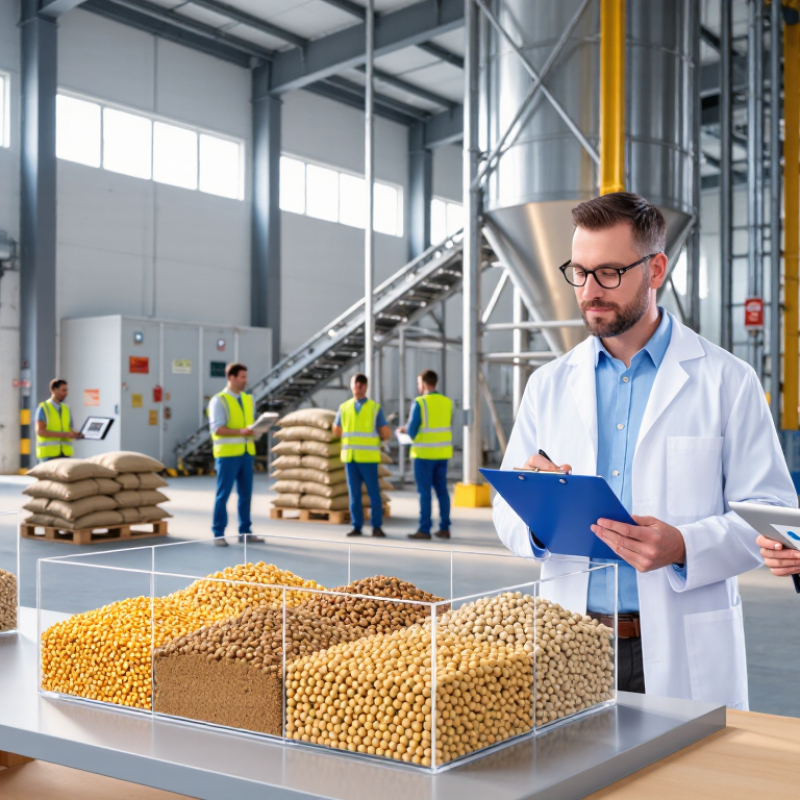
Feed buyers should assess six essential nutrient classes: water, carbohydrates, protein, fats, vitamins, and minerals. Water comes first, although procurement teams often treat it as background. Poor water quality can reduce intake before a laboratory detects a feed imbalance.
Targets must follow species, age, genetics, production stage, and climate. NASEM nutrient requirement tables distinguish dairy cattle, poultry, swine, and aquaculture species for good reason. A laying hen needs substantial calcium for shell formation. A broiler needs digestible amino acids for rapid lean growth. Dairy cattle require effective fiber and fermentable energy for rumen function. The OECD-FAO Agricultural Outlook 2024–2033 projects continued growth in global livestock production, increasing pressure on precise feed formulation. FAO reports also show that feed efficiency remains central to reducing resource use.
Tip: Request a complete nutrient specification, not only crude protein. Check digestible amino acids, available phosphorus, fiber fractions, moisture, salt, and energy values.
Tip: Match the analysis with local conditions. Heat stress, mycotoxin risk, water salinity, and storage humidity can change practical nutrient supply. NASEM values are strong references, but they are not automatic recipes.
Experienced buyers should compare laboratory results with animal performance, manure consistency, shell quality, and feed conversion. One uncomfortable truth remains: a cheaper formula may become expensive through uneven growth or rejected batches. I would also review assumptions every season, because ingredient variability is often underestimated. Nutrient targets are useful boundaries, not perfect promises.
Global feed buyers should compare nutrients on the same dry-matter basis. Otherwise, moisture can make two similar feeds look unequal. A practical first check is crude protein, but protein percentage alone is incomplete. Amino acid balance, digestibility, and nitrogen quality also matter. For many growing pig feeds, protein may sit near 16–20%. Poultry diets often require roughly 18–22%, depending on age and genetics. These are working ranges, not universal rules.
Energy needs a clear unit and system. Poultry commonly uses metabolizable energy, while pig and ruminant diets may use different energy measures. Compare values such as MJ/kg or kcal/kg, and confirm whether they are reported as-fed or on dry matter. Fiber deserves equal attention. High neutral detergent fiber can reduce intake in young animals, while mature ruminants need effective fiber for rumen function. A fiber number without particle size and digestibility can mislead buyers.
Moisture is easy to overlook. Feed containing 12% moisture delivers more nutrients per shipment than feed containing 15%, even when the label matches. Moisture above normal levels can also increase heating, mold risk, and storage losses. Ask for recent laboratory results, sampling methods, and acceptance limits. I have found that supplier averages are useful, but batch variation can be more revealing. A spreadsheet may look exact. The feed bin still tells the truth. Recheck unusual protein, energy, fiber, or moisture results before rejecting a shipment.
This chart compares typical complete-feed purchasing targets for broiler starter, broiler finisher, and layer diets. Protein, crude fiber, and moisture are shown as percentages, while metabolizable energy is shown in MJ/kg. Actual specifications vary by genetics, climate, feed ingredients, and local regulations, so buyers should confirm laboratory results and product tolerances before contracting.
Global Feed Buyers: Control Safety Through Mycotoxin Limits and HACCP Traceability
Mycotoxin control starts before a shipment reaches the port. The FAO estimates that up to 25% of global crops may be affected by mycotoxins. That figure shows the scale of the risk, but it cannot replace lot-specific testing. Buyers should request recent certificates for aflatoxin B1, deoxynivalenol, fumonisins, zearalenone, and ochratoxin A. Testing should reflect the crop, region, season, and intended animal species. One result is never enough.
A HACCP-based purchasing plan should identify hazards from harvest through unloading. Suppliers should document farm origin, storage temperature, moisture records, cleaning actions, and transport conditions. Each lot needs a unique code, sealed retention samples, and a clear chain of custody. Codex CXS 193-1995 provides a useful reference for contaminant limits, but buyers must also check destination-country requirements. Limits differ between feed materials, complete feed, and animal categories. Dairy animals deserve particular attention.
The practical weakness is often sampling. A contaminated pocket can hide inside a large, apparently clean load. Composite sampling improves coverage, yet it can still miss uneven distribution. Buyers should define rejection, quarantine, and retesting rules before contracts are signed. EFSA assessments also show that exposure can involve several mycotoxins at once, not only one regulated compound. A compliant certificate is helpful. It is not proof of zero risk.
10 Animal Nutrition Tips for Global Feed Buyers
Global feed buyers often compare price per tonne, but this can hide the real production cost. In practical farm reviews, I start with feed conversion ratio, or FCR. It measures kilograms of feed used for one kilogram of live-weight gain. A cheaper ration may perform poorly during heat, transport, or inconsistent ingredient quality. Record feed intake, mortality, average daily gain, and weighing dates. Small measurement errors matter. For example, 180 kilograms of feed producing 90 kilograms of gain gives an FCR of 2.0. Cost per kilogram of gain equals FCR multiplied by feed cost per kilogram.
Tips: Compare results from similar animals, housing, and weather. Check feed wastage around bins and troughs. Ask suppliers for clear nutrient specifications and testing records. Use several production cycles before changing a feeding program. One successful batch can mislead you.
Do not judge a ration from its label alone. A feed costing 0.40 dollars per kilogram with an FCR of 2.0 costs 0.80 dollars per kilogram of gain. Another feed costing 0.36 dollars may reach an FCR of 2.4, costing 0.864 dollars per kilogram of gain. The cheaper feed is not cheaper in practice. My own assessments can also be imperfect when farm records are incomplete. Review unexpected results honestly. Water quality, feeder adjustment, animal health, and ingredient storage may explain poor performance. Reliable buying decisions require measured outcomes, not attractive price sheets.
Global feed buyers need more than a low price and a polished sustainability claim. They need evidence that connects emissions, ingredients, and farm-level supply data. The FAO’s widely cited benchmark attributes about 14.5% of human-caused greenhouse gas emissions to livestock supply chains. Treat it as a reference point, not a universal score for every feed supplier.
Tip: Ask suppliers to define their emissions boundary. Does it include fertilizer, land-use change, transport, processing, and farm emissions? Require the calculation year, methodology, and emissions per tonne of feed or protein. Compare like with like. Different boundaries can make identical products appear very different.
Tip: Test supply data against physical records. Request origin documents, purchase volumes, batch numbers, delivery dates, and sustainability certificates. Trace one shipment backward, then check whether the quantities reconcile. A spreadsheet may look convincing. It can still contain gaps.
Feed formulation also affects the result. Review protein efficiency, digestibility, moisture levels, and the inclusion of regional ingredients. Lower transport distance does not automatically mean lower emissions. Land conversion may matter more. Some assumptions remain uncertain, especially where small farms lack complete records. Buyers should document these limitations instead of hiding them. That honesty improves credibility, although it may weaken a sales presentation. Use independent reviews when possible, and revisit the data annually as methods improve.
| No. | Buyer Focus | Verified Data or Benchmark | Recommended Nutrition and Sustainability Check | Primary Reference |
|---|---|---|---|---|
| 1 | Use the global emissions baseline | Livestock supply chains accounted for approximately 14.5% of human-induced greenhouse-gas emissions, equivalent to about 7.1 gigatonnes CO2e per year in the FAO baseline assessment. | Request a product-level carbon-footprint method, system boundary, emission factors, reporting year, and verification status before comparing suppliers. | FAO, Tackling Climate Change Through Livestock, 2013 |
| 2 | Prioritize feed-production hotspots | In the FAO livestock-emissions assessment, feed production contributed approximately 45% of livestock-sector emissions, including land-use change, fertilizer use, processing, and transport. | Evaluate ingredient origin, fertilizer practices, land-use history, processing energy, transport distance, and allocation rules. | FAO, 2013 livestock emissions assessment |
| 3 | Manage enteric-emission exposure | Enteric fermentation represented approximately 39% of livestock-sector emissions in the same FAO global assessment. | For ruminant diets, check forage quality, digestible energy, crude-protein balance, rumen-health indicators, and the evidence behind any methane-reduction claim. | FAO, Tackling Climate Change Through Livestock, 2013 |
| 4 | Check protein supply and amino-acid quality | FAOSTAT reports global soybean production at approximately 375 million tonnes in 2022; soybeans are widely used as a major protein source for animal feed. | Compare crude protein with digestible or metabolizable amino-acid supply, especially lysine and methionine, rather than buying on crude-protein percentage alone. | FAOSTAT, Crops and Livestock Products, 2022 data |
| 5 | Verify energy-ingredient availability | FAOSTAT reports global maize production at approximately 1.16 billion tonnes in 2022, making maize one of the world’s largest feed-energy crops. | Assess moisture, mycotoxin risk, starch content, test-weight consistency, storage losses, and the resilience of the origin’s harvest and logistics. | FAOSTAT, Crops and Livestock Products, 2022 data |
| 6 | Control mycotoxin and food-safety risk | The main regulated or monitored feed hazards include aflatoxins, deoxynivalenol, zearalenone, fumonisins, ochratoxin A, and T-2/HT-2 toxins. | Require risk-based sampling, accredited laboratory methods, batch traceability, storage controls, and species-specific maximum or guidance limits applicable in the destination market. | FAO and Codex Alimentarius feed-safety guidance |
| 7 | Reduce nitrogen and phosphorus losses | Nitrogen and phosphorus efficiency depends on animal species, growth stage, digestibility, amino-acid balance, phytate level, and manure management; no single global inclusion rate is suitable for every diet. | Use digestible amino-acid formulation, phytase where appropriate, phase feeding, and a documented mass balance for nitrogen and phosphorus. | FAO feed and livestock-environment guidance; national feed regulations |
| 8 | Screen land-use and deforestation risk | Commodity-level sustainability cannot be demonstrated by a generic “responsibly sourced” statement alone; origin, production year, farm or aggregation area, and land-use history are required for meaningful verification. | Request geolocation or polygon data where feasible, a deforestation cut-off date, grievance records, supplier mapping, and independent audit evidence. | FAO and international land-use and responsible-sourcing guidance |
| 9 | Use circular and lower-impact ingredients carefully | Feed ingredients derived from food-processing co-products can reduce competition for primary crops, but their nutritional value and safety vary substantially by processing method and source. | Verify dry matter, digestibility, amino-acid profile, oxidation, contaminants, shelf life, and whether environmental benefits were double-counted across products. | FAO circular-bioeconomy and feed-safety principles |
| 10 | Compare diets by animal performance | Feed-conversion results are system-specific and depend on genetics, health, housing, climate, mortality, age at slaughter, and measurement boundaries; a feed ingredient cannot be judged by composition alone. | Compare feed-conversion ratio, average daily gain or egg mass, mortality, product quality, manure output, and CO2e per kilogram of edible protein under the same production boundary. | FAO life-cycle assessment and livestock productivity guidance |